The Other Half of the Family Calendar
Why the next useful technology should help us make room for life.
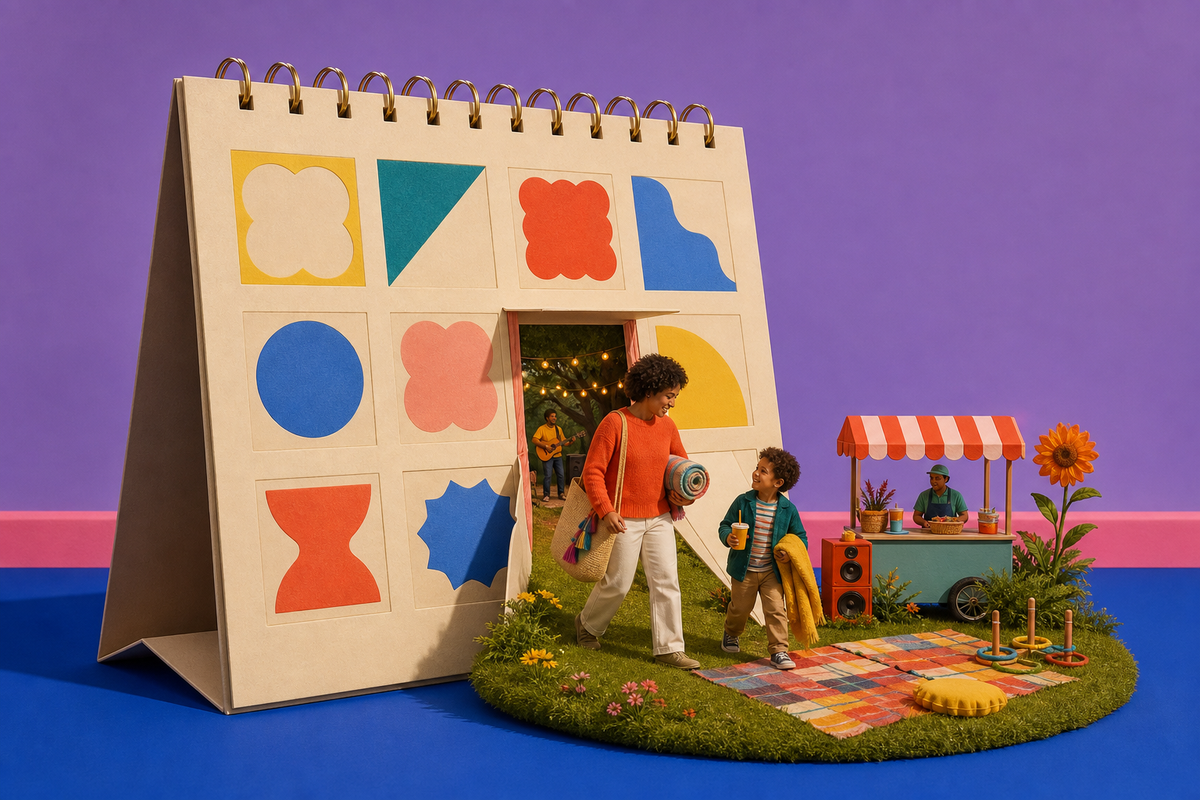
At home, we recently purchased a Skylight calendar. On the surface, it’s a simple thing. A shared place for our family to see the week, remember appointments, avoid double-bookings, and keep the household moving.
But it also exposes something more human.
Most families are not looking for another app to optimize their lives. We are trying to make room for life inside the machinery of it. Work, school, meals, practices, errands, birthdays, bills, and the thousand little things that come with raising kids can turn every week into a loop.
The calendar helps us keep up. What it does not do is help us occasionally step outside of that loop.
It does not tell you that your favorite sports team is playing tonight and this is the one worth staying up for. It does not tell you a musician you would actually enjoy is playing nearby on Saturday. It does not remind you that the tv show you both started after bedtime is back. And it cannot make the blank space between obligations feel like an opportunity instead of another thing left undecided.
That is where I think a more thoughtful kind of technology can help.
Not by putting another feed in front of us. Not by replacing family decisions. And definitely not by treating a home like a new surface for extraction.
At intori, that begins with the things people already care about: sports, music, entertainment, and food. The point is not to create more recommendations. It is to make a few everyday decisions easier, then eventually surface a worthwhile possibility before it passes.
The bigger idea is simple. A household should not have to know exactly what to search for in order to discover something worth making room for.
Busy households are already using it
There is a tempting story that parents are resistant to new technology. The data points in a different direction.
Parents are not waiting on the sidelines. In an April 2026 survey of 1,004 U.S. parents, 81% said they had used AI to help with parenting tasks. Forty-three percent use it weekly, and nearly half have used it for meal planning or grocery lists. More than a third have used it to plan activities or crafts. The survey from Lurie Children’s found that two-thirds of parents say it has reduced their mental load.
This makes sense. A busy household has constant, overlapping decisions. The value is not in having a futuristic conversation with a machine. It is in reducing friction around things that already need attention.
This is no longer fringe behavior. In a nationally representative 2026 survey from Pew Research Center, 61% of adults ages 30 to 49 said they had used AI chatbots such as ChatGPT, Gemini, or Copilot. Thirty-four percent said they use them daily. These are the adults building careers, raising children, and carrying much of the logistical weight of household life. The question is no longer whether this technology enters the home. The question is what kind of relationship it earns once it gets there.
The adoption is real. The enthusiasm is much more conditional.
Use is not trust
There is an important difference between using a tool and welcoming it into your life.
Use does not automatically become trust. A recent Gallup study found that just 36% of U.S. millennials have at least some confidence in AI tools as a source of financial guidance. Even among the generation most accustomed to using these tools, confidence remains conditional.
Parents have every reason to be clear-eyed. In a 2026 Common Sense Media study, 84% of parents said they were concerned about AI misusing children’s and teens’ personal information.
That skepticism is healthy. It is not a failure of imagination. It is an appropriate response to a digital economy that has repeatedly asked people to give up more than it gives back.
We can see the reaction everywhere: physical media, printed planners, old cameras, record stores, analog hobbies, local gatherings, and experiences that cannot be reduced to a feed. This is not simply nostalgia. It is a desire for things that feel intentional, finite, and real.
Our devices are still how we coordinate, discover, and stay connected. The issue is not that digital life exists. The issue is that too much of it has been designed to capture our attention rather than respect it.
We are asking a too-small question
Most conversations about this technology still begin with the obvious uses. Customer service that is cheaper. A workflow that is faster. Research that can handle more volume. A document that can be summarized in seconds.
Those are useful improvements. They are also just the first step.
Using new technology to do old things faster is not the full opportunity. The larger opportunity comes after that, creating experiences that could not exist before because the trust layer was missing.
Imagine the difference between being targeted by a business and being represented by a system that works for you.
In the first version, a company wants access to your attention. It buys data, makes assumptions, and tries to reach you before someone else does. In the second, you decide what parts of your preferences can be used, for what purpose, and under what conditions. A business can offer something relevant, but it does not get to buy its way around your boundaries.
That difference is everything.
If a service earns more when it shows you more things, sells more of your information, or keeps you clicking longer, it has a reverse incentive. It can sound helpful while quietly working against you.
A respectful system should be judged by a much simpler standard… Does it help a person make a better decision while leaving that person with more control than they had before?
Context needs consent
Frontier intelligence will keep improving, but intelligence alone is not enough. Without trust, it is just capability looking for permission.
And after trust comes context.
Real usefulness requires more than a generic request. It requires some understanding of a real life. What someone enjoys, what they have already decided, what constraints they are working within, and what they would rather not spend time on.
But context without ownership becomes surveillance.
The answer is not to avoid personalization. It is to make it understandable and optional. People should be able to see why something appeared, choose what they share, change their mind, and know that a useful answer is not quietly becoming corporate property.
That is why intori begins with questions rather than assumptions. It is why a person can decide what is worth keeping. It is why nothing should land on a family calendar by itself. And it is why the product has no ads and does not sell information about a household.
Trust is not a privacy policy hidden in a footer. It is an experience people can feel.
The moments worth making room for
The most interesting version of this does not end with better recommendations.
It begins when a system can surface one timely, relevant possibility that a household would be glad to know about before it passes.
Maybe it is a local exhibit with one weekend left. A small outdoor show close enough to make after breakfast. An event a child would genuinely love, at a price that makes sense, with enough lead time to decide. The best version does not deliver an endless list. It gives someone a reason to pause and say, “We should do that.”
It explains why the moment surfaced. It shows the date, the cost, and the details that matter. It gives the person a choice to keep it, share it, ignore it, or say it missed.
No hidden sponsor buying priority. No action taken without a human yes.
That is what I mean by a useful unprompted delivery. Not another reason to stay online, but a reason to get out into the world.
We are not there yet. Family moments are the next layer we are building toward at intori, and I think that distinction matters. It should not be a generic feed of “family activities.” It should earn the interruption by being timely, specific, and actually worth making room for.
Starting small, on purpose
For now, intori starts with the decisions already living in a household’s week: what to watch, what game matters, who is playing nearby, and what is for dinner.
It learns from a few answers at a time. It shows what shaped a pick. And when something is worth holding onto, the person decides whether it belongs on the calendar or household display they already use.
That is a modest place to begin, but it is the right one.
The long-term potential is bigger than recommendations. It is a different foundation for how people participate in digital life, one where preferences, permissions, and identity create value for the person first.
But that future has to begin with something useful enough to invite into daily life, careful enough to earn trust, and humble enough to remember that people are not data points waiting to be optimized.
For me, the family calendar is a good place to start.
Not because it needs more technology, but because family life deserves more room for the unexpected, the meaningful, and the real.
Launch note, September 2026
At the time of publishing this, intori is opening a small iPhone TestFlight group.
I’m looking for honest feedback from people willing to try it in a real household, not polished praise. The original testers who participate and share feedback will receive free lifetime access to intori.
If the Beta is still open, send me a message or visit intori.co.